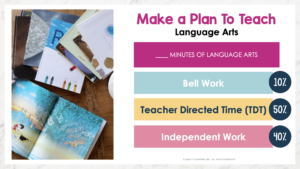

Here’s the honest truth: Not every teacher has a luxurious 100-minute literacy block. Some of you teach multiple subjects. Some share time with French immersion. Some are squeezed by a crowded timetable. And you know what? Your students can still get excellent literacy instruction. You just need to be intentional about what stays, what goes, and what stretches.
THE NON-NEGOTIABLES
Before we talk time, let’s talk priorities. Every single week, your students need:
- Spelling & vocabulary instruction — word work is foundational
- Grammar & conventions teaching — so their writing gets stronger
- Reading and writing practice — but these can be stretched across two weeks if needed
Notice what’s missing? You don’t need fancy centre cards or elaborate prep. You don’t need a specific room setup. You don’t need more time—you need smarter choices.
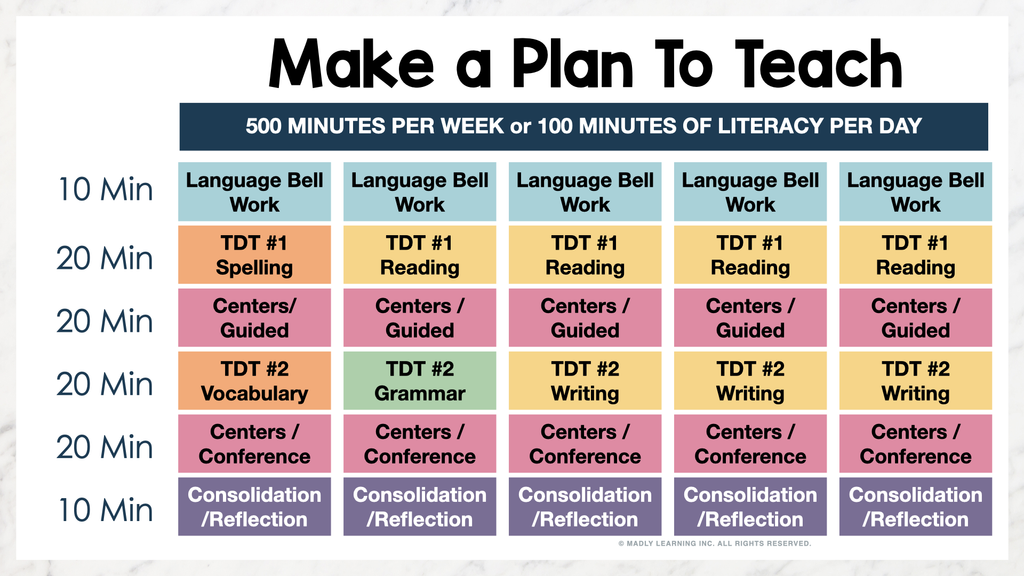
THE 100-MINUTE GOLD STANDARD (FOR REFERENCE)
If you do have the full block, here’s what it looks like:
FULL 100-MINUTE BLOCK
5–10 min — BELL WORK
Independent reading, cursive practice, or games to transition students and build literacy without formal instruction
20 min — TEACHER-DIRECTED (READING & SPELLING)
Modelled and shared reading lessons, comprehension, vocabulary, text analysis, spelling and morphology
20 min — INDEPENDENT CENTRES (ROTATION 1)
Students work on RISE tasks while you confer with small groups
20+ min — TEACHER-DIRECTED (WRITING & GRAMMAR)
Modelled and shared writing, writing process, grammar, conventions, and style
20 min — INDEPENDENT CENTRES (ROTATION 2)
Another round of RISE work or student-teacher conferencing
10–15 min — CONSOLIDATION
Wrap-up, reflection, novel study time, or reinforcement
This structure works because it balances teacher instruction with student independence, builds in transitions to respect attention span, and gives you time to confer with small groups while others are engaged.
Structuring Your Literacy Block: 80 Minutes
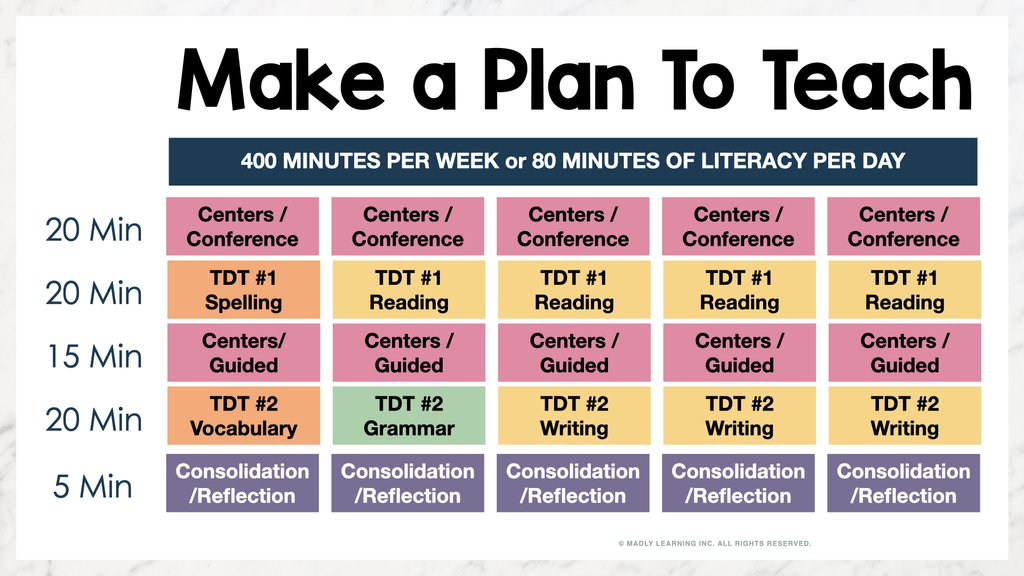
You have 80 minutes a week. Here’s what changes:
80-MINUTE ADAPTATION
0 min — BELL WORK
Drop it. You don’t have time to spare. Students transition directly into centres work.
15–18 min — TEACHER-DIRECTED (READING & SPELLING)
Front-load this at the start of the week. Keep it tight and focused.
15–18 min — INDEPENDENT CENTRES
One solid rotation of RISE work while you confer
15–18 min — TEACHER-DIRECTED (WRITING & GRAMMAR)
Keep lessons tight. Prioritise writing process and conventions.
10–15 min — CONSOLIDATION
Keep this—it’s where learning sticks. Novel study, reflection, or reinforcement.
Key move: You’re cutting transitions and prep time, not instruction. Front-load your spelling and vocabulary instruction early in the week so it has time to settle. You get one solid centre rotation instead of two, which means less juggling—and honestly, that’s fine. Students need depth, not constant switching.
Structuring Your Literacy Block: 60 Minutes
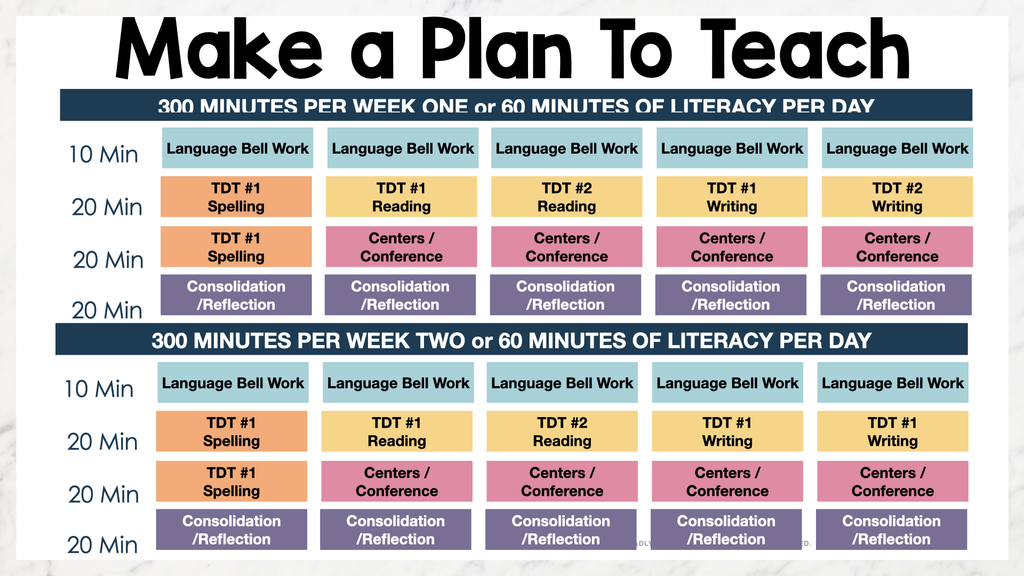
You have 60 minutes a week—maybe you’re a French immersion teacher, or you share your literacy time with another subject. This is tight, but it’s absolutely doable. Here’s the shift:
60-MINUTE ADAPTATION
Every week — NON-NEGOTIABLE
Spelling, vocabulary, and grammar instruction happens every single week. These are quick, focused mini-lessons (8–10 minutes).
Alternating — STRETCH IT OUT
Reading and writing lessons rotate across two weeks. Week 1: deep dive into reading. Week 2: deep dive into writing. Then repeat.
Ongoing — CENTRES WORK
Keep RISE tasks simple and ongoing. Students work on the same centre over multiple days, reducing your prep and giving them time to deepen engagement.
Why this works: Spelling, vocabulary, and grammar are foundational. They build incrementally week by week. Reading and writing need depth—so you give them quality instruction every other week rather than rushed instruction every week. Students still get comprehensive literacy teaching; it’s just stretched strategically.
Real talk: You may hear that you need reading and writing instruction every single week. That’s not wrong—ideally, yes. But with 60 minutes total, you’re choosing between rushed daily instruction or rich bi-weekly instruction. The second option actually teaches more, because students have time to apply what they learned before moving on.
WHAT’S RISE AND WHY IT MATTERS
Regardless of your time frame, your independent centre work should follow the RISE format. This is your workhorse when you’re stretched thin.
RISE CENTRE TASKS (REPEATABLE & LOW PREP)
R — READ & RESPOND
Must do: Respond to the week’s text in writing or through a task. May do: Independent reading or reading games.
I — INDEPENDENT WRITING
Must do: Work on a current writing piece. May do: Free writing or story work. (Pro tip: Students are never done writing, so this is always the default when they’re stuck.)
S — SPELLING & VOCABULARY
Must do: Work on this week’s word list or vocabulary task. May do: Word games or additional activities.
E — EDITING & GRAMMAR
Must do: Work on assigned grammar or edit their own writing. May do: Grammar games or additional practice.
The beauty here? These are the same tasks, repeated and rotated. A piece of paper with the week’s assignment is often enough. No elaborate centre cards. No Pinterest-perfect setups. Just clear expectations and consistency.
BELL WORK: SHOULD YOU KEEP IT?
In the 100-minute block, bell work is a game-changer. It’s a transition buffer that helps junior students settle and builds automaticity in reading or handwriting.
In the 80-minute block? You can skip it if you need to. Instead, transition directly into centres. Students still get that transition time within the centres activity itself.
In the 60-minute block? Absolutely skip it. Every minute counts. Your centres work becomes your buffer time.
If you really want it: Use games, independent reading, or cursive practice. Keep it 5 minutes, max. Don’t prep anything new—reuse what you already have.
TIME MANAGEMENT: THE REALITY CHECK
Here’s what the research doesn’t show you: lessons take longer than you plan. A reading comprehension lesson lands, and a student asks a question that opens an entirely richer discussion. A spelling pattern clicks, and you want to solidify it further. And that’s not a problem—that’s good teaching.
So here’s the rule:
- Use a timer. Be realistic about what things take.
- If a lesson runs over because it’s rich and responsive, that’s a good call. Don’t rush through learning.
- If you consistently run long, adjust next week. Maybe your mini-lessons need to be even shorter, or maybe you need to front-load less content earlier in the week.
- Never swing so hard toward efficiency that you stop being responsive to your students.
The structure is a guide, not a prison. It gives you a container, but your teaching—your responsiveness, your flexibility, your professional judgment—lives inside it.
BUFFER WEEKS: THE SECRET WEAPON
Whether you have 60, 80, or 100 minutes, you need buffer weeks built into your year. These are weeks where you aren’t starting a new unit or diving into new concepts. Instead, you consolidate. You let things breathe. You catch up if you’ve run over.
Why? Because the structure assumes everything runs on time—and it won’t. A concept needs an extra day. A student needs more practice. A snow day eats your Tuesday. A supply teacher covers and pulls your students a different direction.
Buffer weeks let you be both responsive and realistic. Without them, you either abandon responsiveness to stay on schedule, or you fall progressively behind all year. With them, you adapt and still finish strong.
WHAT DOESN’T CHANGE
No matter your time frame, these things stay the same:
- Consistency matters. Same structure, same expectations week to week. This teaches self-management.
- Modelled and shared instruction matter. You can’t skip the “I do, we do” part of the lesson and expect independent work to land.
- Conferencing with students matters. While they’re in centres, you’re meeting with small groups to teach, listen, and assess.
- Writing is never done. Independent writing is always the default centre. This kills the rushing-through problem and builds stamina.
- Movement and transitions matter. Even with a tight schedule, build in the breaks. They’re not fluff—they’re how junior brains reset and refocus.
THE REAL QUESTION
You probably started reading this post asking, “How do I fit everything in?” But the better question is: “What actually matters, and am I teaching that with quality?”
A 60-minute block with solid mini-lessons, consistent centres, and real conferencing time beats a 100-minute block rushed through PowerPoint slides. Depth beats coverage. Responsiveness beats rigid adherence to a plan.
You don’t need more time. You need clarity on what matters, a structure that scales, and permission to adjust when real teaching happens.
You’ve got this.
Ready to build your own literacy block? Start with what you have, track what actually takes time, and adjust from there. Consistency and responsiveness, week after week, will get your students further than any perfect plan.