
There's a particular feeling that arrives every spring in elementary classrooms. The sun starts warming the windows, the kids get a little louder, a little more restless, and even the most carefully planned lessons start to compete with the pull of the outdoors.
I remember a season when I stopped fighting that pull and started working with it.
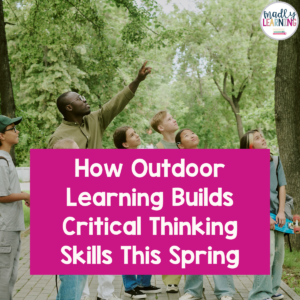
What I found was something I didn't expect: outdoor learning and critical thinking are not two separate goals. They feed each other. When students step outside, they encounter real environments that raise real questions. And real questions are exactly where genuine thinking begins.
This post brings those two ideas together. You'll find low-prep outdoor learning activities to take across subject areas this spring, plus a closer look at how these experiences actually build the critical thinking skills our students need most right now.
Why Critical Thinking Needs More Than a Worksheet
Critical thinking is not simply about getting the right answer. It's the ability to analyse information, draw conclusions, evaluate what you've gathered, and synthesise ideas from multiple sources into something that makes sense. These are higher-order skills, and they require the kind of rich, complex experiences that are hard to replicate at a desk.
The reality is that over the last few years, a lot of classroom time has been focused on knowledge and understanding: the content, the facts, the foundational pieces. That was necessary. But it's also left a gap. Students are often less practised at the thinking skills that sit above basic recall: asking deeper questions, forming opinions and supporting them with evidence, making connections across ideas.
The good news? Going outside is one of the most natural ways to create those opportunities. And it does not require a big plan.
Low-Prep Outdoor Activities That Build Real Thinking
These activities are designed to take a subject area outside while naturally building the kind of thinking skills we want students to practise. You do not need a perfect day or a perfect plan. You need a question and a direction to walk.
Ask students to draw a map of the schoolyard, labelling natural and human-made features and identifying how different spaces are used. This is a land-use and community structure lesson that gets them observing, classifying, and drawing conclusions, all without a photocopied page in sight.
Take a walk around the school grounds and ask students to observe how people interact with the space. What rules are in place? Who is the space designed for? These questions move students from simply looking to actually evaluating and thinking critically about their community.
Give students a journal and take them outside to sketch, observe, and write about what they find. Ask them to record questions alongside observations, not just what they see, but what they wonder. This is metacognition in action: thinking about their own thinking process as learners.
Take your read-aloud or guided reading groups outside. A change of environment shifts the energy, and discussion questions feel more natural when students aren't sitting in rows. Ask open-ended questions that have no single right answer. What do you think? Why? What would you have done?
Give students measuring tools and a challenge: find something taller than one metre, estimate the area of the basketball court, map the perimeter of the garden. Real measurements require real thinking: estimating, adjusting, reasoning about whether an answer makes sense.
The Critical Thinking Connection
Outdoor learning works as a critical thinking tool because it is inherently open-ended. There is no answer key for what students observe in the schoolyard. There is no single correct conclusion when they evaluate how a community space is designed. The environment asks them to think, and that is exactly what we need them practising.
A few teaching moves can deepen the thinking even further.
- Start with a question, not a task. "What do you notice? What surprises you?" shifts students into inquiry mode before they've taken a single step outside.
- Follow the spark of curiosity. If students get animated about something unexpected, go with it. That engagement is not a tangent. It is an entry point to genuine thinking.
- Build in a metacognitive reflection. When you return inside, ask students to think about their thinking: "What made you curious? How did you decide what to record? Did anything change your mind?"
- Validate multiple right answers. Critical thinking questions rarely have one correct response. An answer is a good answer when it is supported by evidence and explained with reasoning, not because it matches what the teacher expected.
Practical Tips for Making It Work
The most common reason teachers don't go outside more often is not lack of interest. Here's how to keep it manageable. Here's how to keep it manageable.
Which Outdoor Learner Are You?
Listen: Episode 246, Build Critical Thinking Skills in the Classroom
In this episode of Ignite Your Teaching, Patti digs into the critical thinking gap that's showing up in classrooms right now: what caused it, what it looks like, and practical strategies to start filling it. If you want the deeper conversation behind this blog post, this is a great place to start.
Take It Outside: Even Just a Little
You don't need a full outdoor education plan to make this work. You just need one question and a willingness to follow where your students go with it.
This spring, I hope you find at least one afternoon where the best thing you can do is open the door and step outside together. Ask a question. Watch what happens. Follow the curiosity. You might be surprised where it leads.
With you in the work,
Patti