
When I first started teaching Science and Social Studies, I treated the curriculum like a checklist.
One expectation. One lesson. Teach it until everyone gets it. Don’t move on until they do.
You can probably guess how that worked out. I was behind constantly, overwhelmed regularly, and never felt like I was actually teaching — I was just ticking boxes.
Then I got a split-grade classroom. Suddenly I wasn’t managing one grade’s curriculum — I was managing two. And the checklist approach didn’t just stop working. It collapsed entirely.
I had to find a completely different way to think about it. And what I discovered changed how I’ve taught both subjects ever since.
The Moment That Crystallised Everything
A few years into my career, I had a student teacher placed with me. She was doing well — thoughtful, enthusiastic, clearly cared about the kids.
Then one morning, about 20 minutes before our Science block, she came to me and said she hadn’t planned a lesson for pulleys and gears.
Not because she’d run out of time. Because she didn’t understand it well enough to teach it. So she hadn’t planned anything at all. She was hoping I could just cover for her.
I did. But I’ve thought about that moment ever since, because it wasn’t really about her. It was about something I see in teachers everywhere, including in myself early on.
We are generalist teachers. We are expected to teach literacy, math, science, social studies, health, the arts, and more — often in subjects we haven’t studied since high school. We want to teach these subjects well. But when we don’t have the content knowledge and don’t have time to develop it deeply, the path of least resistance is to find a basic resource, read it to the kids, fill out a worksheet, check the box, and move on.
And when we do that, something happens in classrooms that we don’t talk about enough: students go through the motions, pass the test, and retain almost nothing.
The Problem with Checklist Teaching
I understand why it happens. I lived it.
When you see a curriculum document with dozens of specific expectations, the natural instinct is to treat each one as a separate item to deliver. Teach it. Test it. Move on.
But that’s not how learning actually works — and it’s definitely not what the curriculum is asking for. The curriculum expects big-picture thinking, application, and higher-order skills. It expects students to do something with the content. And you can’t get there by delivering facts and hoping they stick.
The teachers who feel most overwhelmed by Science and Social Studies are almost always the ones who are trying to teach every single expectation in isolation. It’s exhausting because it was never designed to work that way.
Here’s the shift that made everything click for me: stop reading the curriculum as a list of things to teach and start reading it as a description of things students should understand by the end.
When you orient around big ideas instead of individual expectations, something remarkable happens. You stop feeling behind. You start feeling like you’re actually teaching.
The Structure That Freed Me
Once I let go of the checklist, I needed something to replace it with. What I landed on was a consistent four-part lesson format that I now use for every single Science and Social Studies lesson I teach.
Every lesson has four parts:
The Hook — before I teach anything, I spark curiosity. A question, a provocation, a challenge, an image. Something that makes students need to know the answer before I’ve given it to them. This is not optional. If students aren’t leaning in at the start, the lesson is already working against itself.
The Lesson — focused, direct teaching tied explicitly to the curriculum expectation. Not fifteen things. One clear idea, taught well. This is where teacher notes and content support matter enormously — you can’t hook students with a question you don’t understand yourself.
The Activity — this is where the actual learning happens. Hands-on, inquiry-based, and where students do something with the content rather than receive it. This is the part most checklist teachers skip because it feels risky. It doesn’t fit neatly in a worksheet. But it’s the part students remember.
The Consolidation — bringing it back together before the bell. What did we learn? What are we still wondering? What changed in our thinking? This is where understanding sticks and where you can quickly assess who has it and who needs more.
What This Looks Like in a Real Classroom
Let me show you exactly what this structure looks like in practice with two of our Ignited Lessons Club lessons — because theory only takes you so far.
Example 1: Pulleys and Gears – Machines and Mechanisms
The hook for this lesson isn’t a worksheet about what a pulley is. It’s a question: “If I asked the smallest person in the class to pull two of the strongest students together using only a rope — could they do it?”
That question does something to a room. Suddenly, everyone has an opinion. The lesson that follows — on mechanical advantage and how increasing the number of pulleys decreases the force required — is something students are already invested in before you’ve said a word about curriculum.
From there, students move through three hands-on experiments: a tug-of-war pulley challenge using broomsticks and rope, a single pulley system using a fish scale to measure actual force, and a double pulley system where they discover that doubling the pulleys nearly halves the effort required. They record their observations and hypotheses in a science foldable, then consolidate with a Square-Triangle-Circle exit ticket — what squares up with what you believed, what three things you want to remember, and what questions are still circling in your brain.
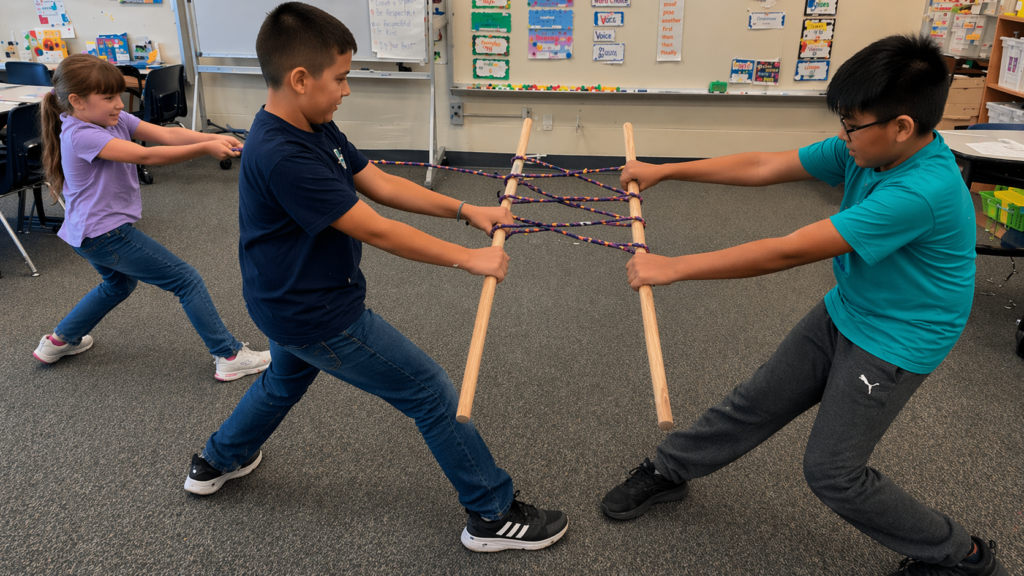
The beauty of this lesson is that I don’t need to be a mechanical engineering expert to run it. The teacher notes explain the key understanding — that force decreases as the number of pulleys increases, but distance required to pull also increases — so I can teach with confidence even if pulleys and gears isn’t my strongest area.
This lesson can be found inside our Ignited Lessons Club Membership
Example 2: Human Body Systems — Human Blood
The hook here is deceptively simple: “Is blood all one thing, or is it a mixture of many things?”
Most Grade 5 students assume blood is just blood. The reveal that it’s actually four distinct components — plasma, red blood cells, white blood cells, and platelets — each with its own job, is genuinely surprising to them. That surprise is the hook.
Students read job cards describing each component in accessible language — plasma as the truck driver, red blood cells as the pilots, white blood cells as the soldiers, platelets as the nurses — and summarise each one in their own words. Then they make their own blood using household materials: yellow-dyed water for plasma, red-dyed Cheerios for red blood cells, mini marshmallows for white blood cells, and star-shaped puff cereal dyed red for platelets.
They assemble it in a jar, shake it up, and see for the first time what blood actually looks like at a component level.
The consolidation is a written reflection with a rubric, asking them to explain what each component does and what the experiment taught them that they didn’t know before.
This lesson covers multiple curriculum expectations in one session. It’s hands-on. It’s memorable. And students who did this lesson will remember what plasma does years from now in a way that students who filled out a diagram will not.

The Long-Range Planning Piece
The four-part lesson structure only works if you have a plan for where each lesson fits across the year. Without that, you end up scrambling week to week — which is exactly how most teachers end up back in checklist mode.
Here’s how I map my year for Science and Social Studies:
For Science, I plan four units of approximately five weeks each. That’s 20 weeks of focused, sequential science teaching across the year.
For Social Studies, I plan two units of approximately eight weeks each. That’s 16 weeks.
Combined, that’s your 36-week year mapped before September starts. Science and Social Studies never compete with each other because they run sequentially — I finish one before I start the other. And I aim for 100–150 minutes of dedicated time each week, split across two or three sessions.
When you see the whole year at once, the panic of “how am I going to fit it all in” goes away. You have a plan. You know what’s coming. And when the fire drill happens on Thursday and wipes out your lesson, you’re not derailed — you’re just one session behind in a schedule that has room for that.
Grab our Long Range Plans https://madlylearning.com/sp/lrp/
The Generalist Teacher’s Secret Weapon
I want to come back to my student teacher and the pulleys lesson for a moment, because I don’t think her situation was unusual. I think it’s the silent reality for a huge number of elementary teachers.
We were trained to be excellent literacy and numeracy teachers. Most of us were not trained to be science specialists. And when the curriculum asks us to teach concepts we don’t deeply understand, we either fake it or avoid it — and both options shortchange our students.
This is exactly why we built the Ignited Lessons Club the way we did. Every lesson includes teacher notes that explain the key concepts in plain language, so you can teach with confidence even in topics you haven’t studied since you were a student yourself. The lesson structure is built in. The activities are designed. The exit tickets are ready.
You don’t have to choose between teaching a rich, engaging lesson and getting home at a reasonable hour. You can have both.
The Lesson I Had to Learn First
Here’s what I know now that I wish I’d known at the beginning: by letting go of the checklist, I could do more. Not harder. More.
I stopped teaching one expectation at a time and started teaching big ideas that covered multiple expectations at once. I stopped waiting for everyone to master a concept before moving forward and started trusting the spiral — that ideas get revisited, deepened, and consolidated over time. I got comfortable with lessons that felt a little less controlled, because the evidence in my students’ faces and their work told me they were actually learning.
That shift — from delivering content to designing experiences — is available to every teacher. You don’t have to be a Science specialist. You don’t have to spend your Sundays building lessons from scratch. You just need a structure that works and resources you can trust.
The four-part lesson is that structure. The Ignited Lessons Club is those resources.
???? [Explore the Ignited Lessons Club here] www.ignitedlessonsclub.com
Talk soon, Patti