
The exact weekly framework I use — and why consistency is the point
One of the questions I get asked most often is some version of this: how do you actually fit it all in?
Not in theory. Not in a perfect week where nothing goes sideways. In real life, with real kids, in a real classroom that has interruptions and behaviour and split grades and a curriculum that never seems to shrink.
My answer is always the same: I don’t wing it. I have a structure for each block, and I use it every single week.
This isn’t about being rigid. It’s actually the opposite. When the structure is consistent, you stop spending mental energy on how you’re going to teach and you can focus entirely on what you’re teaching. Your students stop asking what’s happening next. Your lessons stop feeling like you’re starting from scratch every day.
Here’s exactly how I structure each of my three core teaching blocks.
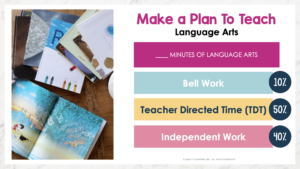
The Literacy Block — 80 Minutes Per Day, 400 Minutes Per Week
Literacy gets the most protected time in my week. Eighty minutes every single day, non-negotiable. That’s 400 minutes across the week, and every minute has a job.
The block runs the same way every day, with one variation on Monday for spelling. Here’s the breakdown:
20 minutes — Centres / Conference
Every literacy block opens with centres. Students move into their independent work immediately, which means I can use this time for conferencing — pulling individual students, checking in on writing, doing a quick reading conference. This is not free time. Students know exactly what they’re doing, and the routines for centres are so well established that I rarely need to redirect anyone.
20 minutes — TDT #1 (Teacher-Directed Teaching)
The first teacher-directed teaching slot is focused on one of two things: spelling on Mondays, or reading for the rest of the week. This is explicit, direct instruction. I’m at the front, I’m teaching a skill, and students are engaged with me. Twenty minutes is enough time to teach something well if you’re focused on one thing.
15 minutes — Centres / Guided
Students return to independent work while I pull a small group for guided reading or guided writing. This is where the differentiation happens. Different groups, different levels, targeted instruction. The rest of the class is running independently — which only works because the routines are solid.
20 minutes — TDT #2 (Teacher-Directed Teaching)
The second direct teaching slot rotates across the week: vocabulary on Monday, grammar on Tuesday, and writing for Wednesday through Friday. Writing gets the most time because it deserves it — it’s the hardest skill to teach and the one students need the most explicit instruction in.
5 minutes — Consolidation / Reflection
Every block ends with a brief consolidation. What did we learn today? What are we working on? This is where the learning sticks. Five minutes doesn’t sound like much, but it’s the difference between a lesson that trails off and a lesson that lands.
Why this structure works
The key insight behind the literacy block is that students are never waiting. While I’m teaching one group, the rest are working. While I’m conferencing, students are in centres. The block is designed so that independent and teacher-directed time are woven together, not stacked on top of each other.
It also means I’m seeing every student in a meaningful way across the week — not just whole-class instruction, but small group and one-on-one. That’s where real literacy growth happens.
The Math Block — 60 Minutes Per Day, 300 Minutes Per Week
Math gets sixty minutes every day. The structure is slightly different from literacy — it runs in four clear phases, with one day per week dedicated entirely to inquiry and journalling.
10 minutes — Math Warm Ups
Every single math class starts the same way: a warm up. This is not optional and it is not wasted time. Warm ups activate prior knowledge, build number sense, and get students thinking mathematically before the lesson begins. They also give me time to take attendance, settle the room, and prepare for the lesson without losing instructional time.
25 minutes — Teacher Lesson (Monday to Thursday) / Math Inquiry (Friday)
Monday through Thursday, this slot is direct instruction. One concept, taught clearly, with examples and guided practice. Twenty-five minutes is enough for a focused lesson when you’re not trying to cover three things at once.
Friday is different. Instead of a teacher lesson, Friday’s 25-minute slot is Math Inquiry — an open-ended problem or challenge that asks students to apply their thinking across multiple concepts. This is where the deeper mathematical reasoning happens, and it’s also the day that tends to surprise teachers the most when they first try it. Students who struggle with direct instruction often shine in inquiry.
15 minutes — Centres and Guided (Monday to Thursday) / Math Journal (Friday)
Monday through Thursday, students split between centres and guided math — half the class working independently at centres while I pull a small group for guided instruction. Friday, this slot becomes Math Journal time, where students reflect on their learning, explain their thinking in writing, and make connections to what they’ve been working on.
10 minutes — Reflection / Flex Time
Every math block ends with ten minutes of reflection and flex time. This might be a consolidation conversation, an exit ticket, a brief sharing of strategies, or flex time for students who need additional support or extension. It’s the hinge that connects today’s lesson to tomorrow’s.
Why this structure works
The math block is built around the idea that different kinds of mathematical thinking need different kinds of time. Direct instruction, independent practice, small group support, open-ended inquiry, and reflective journalling all serve different purposes — and all of them matter. By giving each its own dedicated slot, nothing gets squeezed out.
The Friday inquiry and journal day is particularly important. It breaks the repetition of the week in a productive way and signals to students that math isn’t just about getting the right answer — it’s about thinking and reasoning and explaining.
The Science and Social Studies Block — 100 to 150 Minutes Per Week
Science and Social Studies work differently from literacy and math. Rather than a daily block, I dedicate 100 to 150 minutes per week to these subjects, and I run one at a time — not both simultaneously.
Every lesson, regardless of topic or grade, follows the same four-part format:
Hook — a provocation, question, or challenge that sparks curiosity before any teaching has happened. This is the most important part of the lesson and the most commonly skipped. If students aren’t leaning in at the start, the lesson is working against itself from the beginning.
Lesson — direct, focused teaching tied to the curriculum expectation. Not fifteen things. One clear idea, taught well.
Activity — hands-on, inquiry-based, where students do something with the content. This is where the learning actually happens. It looks less controlled than a worksheet and it’s worth it.
Consolidation — bringing it together before the bell. What did we learn? What are we still wondering? Where does this connect to what we already know?
For the year-level planning, Science runs as four units of approximately five weeks each — 20 weeks total. Social Studies runs as two units of approximately eight weeks each — 16 weeks total. That’s your 36-week year accounted for before September even starts, with Science and Social Studies running sequentially so they never compete with each other for time or attention.
The Bigger Picture
When you look at all three blocks together, the total comes to approximately 760 minutes of structured instructional time per week — before you’ve added any other subjects. That’s not small.
But here’s the thing: none of this feels heavy when the structure is consistent. Because students know what’s coming, transitions are smooth. Because each block has a clear beginning, middle, and end, there’s no ambiguity about what happens next. Because the format is the same every week, your planning becomes about content — not about figuring out how to run the lesson.
The structure is not the cage. The structure is the thing that sets you free.
It frees you to focus on your students instead of your schedule. It frees you to have the small group conversations that change a student’s trajectory. It frees you to walk into Monday morning knowing exactly what the week looks like — and knowing that when Friday’s fire drill happens, you’re not derailed. You’re just one lesson behind in a plan that has room for that.
That’s what teaching from a structure feels like. And it’s available to every teacher, in every classroom, at every grade.
???? [Learn more about Ignited Literacy here]
???? [Learn more about Ignited Math here]
???? [Learn more about Ignited Lessons Club: Science and Social Studies here]
Talk soon, Patti