
The physical layout of your room shapes how well your systems work. In an Ignited Literacy classroom, you need three clear zones:
- a whole group teaching space (Carpet or desk arrangement where all students can clearly see the teaching space)
- a small group area for guided reading and writing conferences,
- independent work areas for centres (student desks or flexible seating options)
Systems
Create a hand in bin for each subject
- Reading Response
- Writing
- Spelling/Grammar/Vocabulary
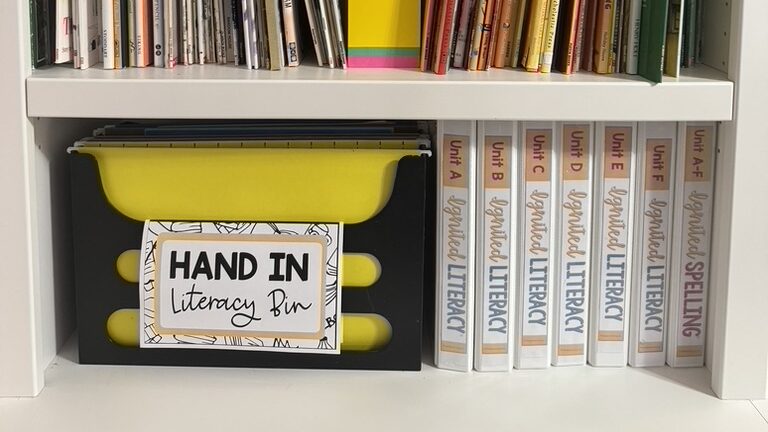
Hand-in bins should be clearly labelled and placed where students can submit work without lining up or interrupting you.
A single supply station keeps materials organized and stops students from wandering.
Literacy Zone on Your Wall
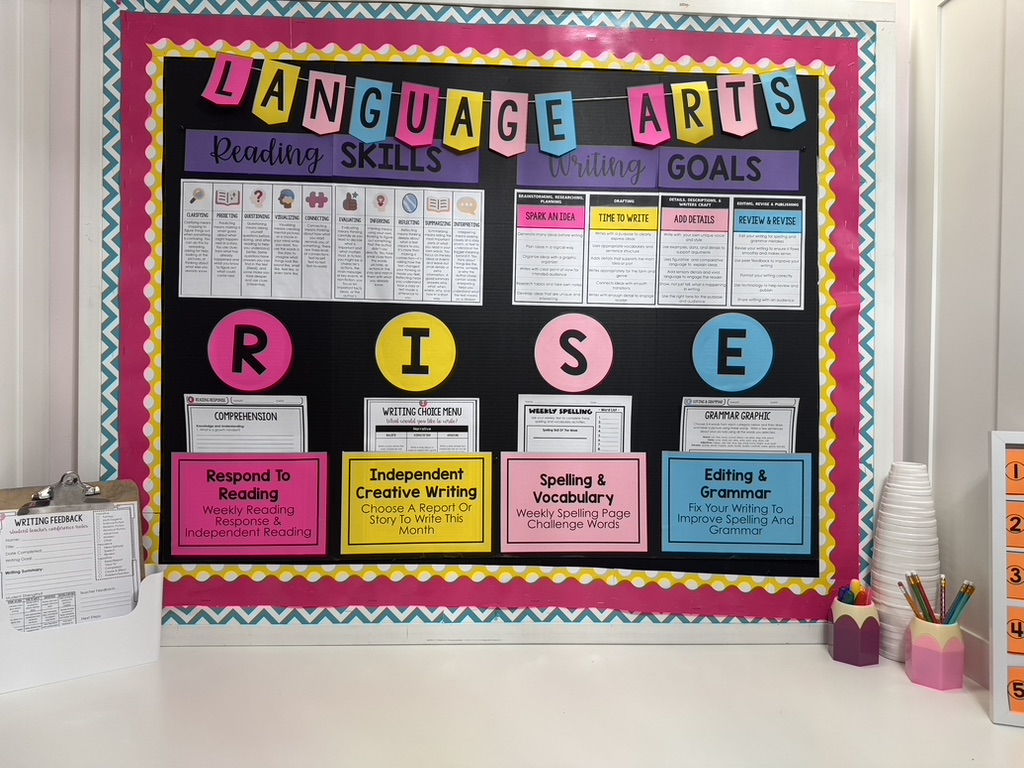
Anchor charts should be introduced gradually and posted where students can see them. Our literacy organization station is a great place to start. It is only available within our Ignited Literacy membership.
Routines
The routines you establish on day one will carry your classroom all year.
Entry routines set the tone. Students should walk in quietly, gather materials, and begin bell work or a centre task right away. This time should feel calm and student-directed. Transitions are smoother when you use both visual and auditory cues.
A timer on the board gives students a warning, and a chime signals the exact moment to move. Students should be able to transition within one minute. Noise expectations are clear and simple.
During lessons, students raise their hands to share.
During independent work, soft music plays. If they cannot hear the music, they are too loud.
End each block by having students put work away and reset the space.
Routines must be retaught whenever they slip.
Consistency is what makes them work. Action Step: Write your entry, transition, and closing routines on a chart and practise them with your class until they become automatic.
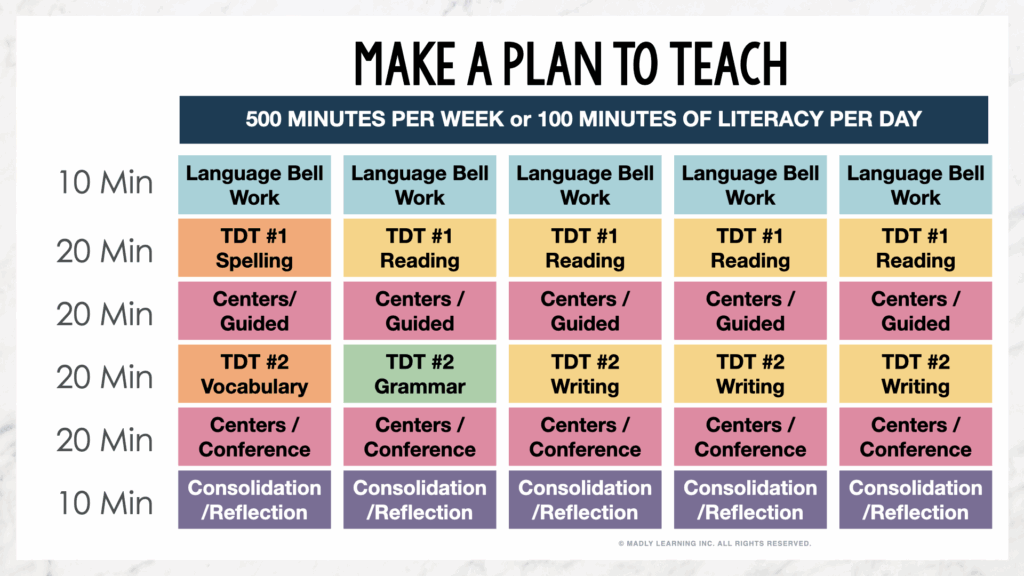
100 Minute Block
Ignited Literacy works best in a predictable schedule.
A 100-minute block each day keeps everything balanced. Students know what to expect, and you can protect time for each part of literacy.
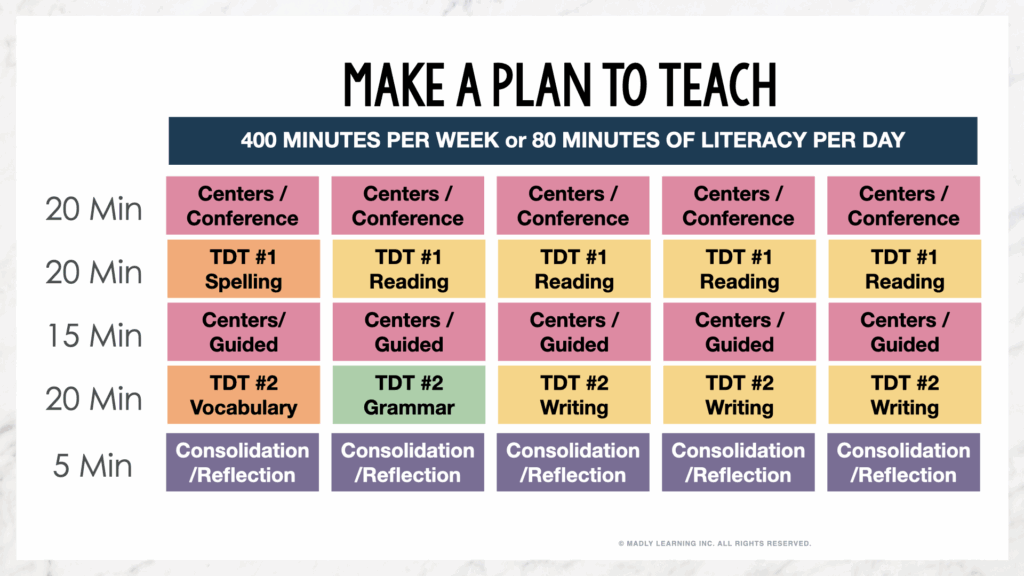
TDT=Teacher Directed Time
A typical block looks like this:
Ignited Literacy works best in a predictable schedule.
A 100-minute block each day keeps everything balanced. Students know what to expect, and you can protect time for each part of literacy.
A typical block looks like this:
Independent Learning and Accountability
A successful literacy block is not about the teacher doing all of the work. It is about creating a classroom where students take ownership of their learning. When students are independent and accountable, you gain the freedom to teach in small groups, and they gain the confidence that comes from managing their own progress.
Why Independence Matters
Students need time to practise literacy skills without constant teacher direction. Independence allows them to make choices, take risks, and see the results of their efforts. It shifts the responsibility for learning from teacher to student, reinforcing the belief that “I am in charge of my own growth.”
Building Stamina
Independence does not happen overnight. It is built in layers. Start by setting clear expectations for routines such as entering the room, beginning work, and transitioning between tasks. Model what success looks like and practise together. Increase the amount of independent work time gradually. Celebrate progress so students see themselves improving in real time.
Clear Systems
Independence requires structure. Systems like hand-in bins, posted due dates, and visual or auditory timers provide students with the cues they need to stay on track. These tools reduce dependence on the teacher and create a predictable flow. When systems are consistent, students feel safe taking responsibility for their own work.
Accountability as a Non-Negotiable
Accountability means that students understand their choices have consequences. If they use their time well, they meet deadlines and feel the satisfaction of success. If they choose not to engage, they experience the natural consequence of incomplete work. Regular check-ins, conferences, and posted expectations keep accountability front and centre.
Supporting Student Choice
Choice is powerful for motivation, but it comes with responsibility. By offering meaningful options within centres—such as which text to respond to or which writing project to continue—students learn to manage their preferences alongside the requirements of the program. This balance supports both independence and accountability.
Reinforcing and Re-Teaching
Even the best systems need reinforcement. Independence and accountability are not “set it and forget it” routines. When students struggle, pause to reteach expectations. Consistency and persistence show students that these routines are not optional—they are the foundation of the classroom.
Centers
In Your Classroom, one of the most important pieces of Ignited Literacy is the way centres are structured and sustained.
Centres provide students with meaningful practice while giving the teacher time for guided groups. But for centres to work, they must be built on intense routines and consistent expectations. This post will walk you through how to set up and establish your centres, using the RISE framework:
- Reading Response,
- Independent Writing,
- Spelling and Vocabulary
- Editing and Grammar.
Why Centres Matter
Centres are not busy work. Each activity has a clear connection to your language program, reinforcing skills that students need every day. When done well, centres create independence, accountability, and choice. They allow students to engage in tasks that are familiar, predictable, and purposeful. Most importantly, they give teachers the opportunity to meet with small groups without interruption.
Introducing Centres to Students
Centres should never be rushed. At the beginning of the year, you will spend time teaching and practising each routine before expecting students to work independently. Start by modelling what success looks like. Show students how to gather materials, how to transition, and how to begin work without waiting for instructions. Build stamina gradually by increasing the time spent at each centre. Reinforce routines daily and revisit them whenever needed.
The RISE Framework
The RISE framework keeps centres simple, balanced, and connected to the core of literacy instruction. Each centre is designed to be flexible, reusable, and meaningful.
Reading Response
Students deepen their comprehension by responding to texts they are reading in guided lessons or independently. They practise strategies such as predicting, inferring, summarising, and making connections. Tasks are often choice-based, giving students ownership while keeping the work aligned to curriculum goals. Reading Response helps ensure comprehension strategies are applied consistently.
Independent Writing
Writing never really ends, which is why there are no early finishers in Ignited Literacy. Students always have something to write. In this centre, they choose from writing prompts, personal projects, or extensions of classroom lessons. They draft, revise, and edit in ongoing cycles, reinforcing that writing is a continual process. Independent Writing gives students daily practice in authentic, self-directed writing.
Spelling and Vocabulary
This centre focuses on strengthening word knowledge. Students practise assigned spelling patterns and vocabulary words through reusable, hands-on activities. These might include word sorts, sentence building, or games. Activities are differentiated so students work at their level while still being challenged. Spelling and Vocabulary work is never isolated; it connects directly back to their reading and writing.
Editing and Grammar
Students learn to apply grammar skills and editing strategies in meaningful ways. Using mentor texts, teacher examples, or their own writing, they practise editing sentences, correcting errors, and revising for clarity. Editing and Grammar builds precision and helps students transfer skills into all areas of their literacy work.
Sustaining the Routine
Once the four centres are introduced, the key to success is consistency. Students need to know exactly what is expected each time they rotate. Transitions are signalled with visual or auditory timers. Success criteria are reinforced daily.
Accountability is built into the system through hand-in bins, due dates, and conferencing. Over time, students become increasingly independent, allowing the teacher to focus on guided groups.