
Struggling to make guided reading work for your junior students? You’re not alone. Once students move beyond decoding and fluency, it can be hard to know what guided reading in junior grades should look like. In this post, I’ll show you how I structure my reading groups, organize a four-week rotation, and get the most out of short guided sessions in grades 4–6 classrooms.
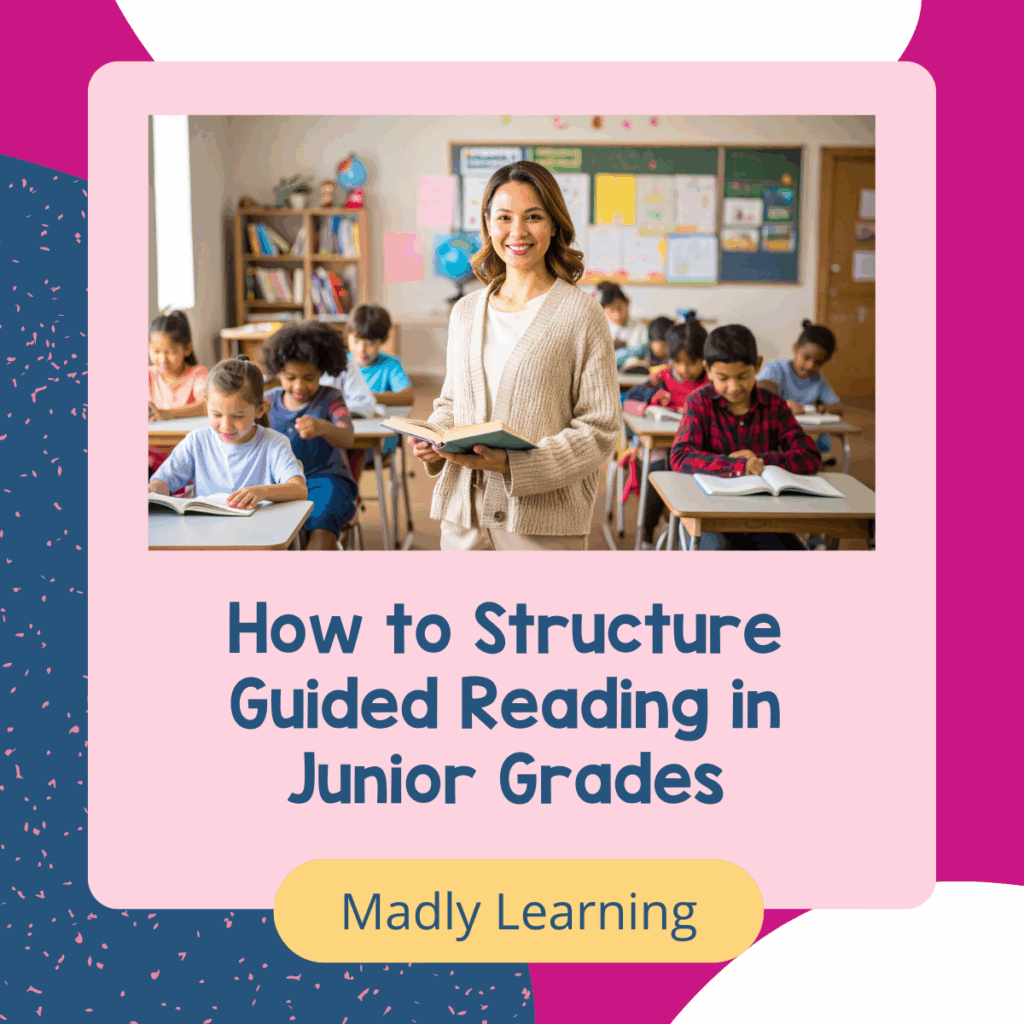
Why Guided Reading in Junior Grades Looks Different
Unlike primary grades, where decoding and fluency are the focus, guided reading in junior grades shifts toward deeper thinking: analysis, evaluation, and inference. Students are ready to tackle complex texts, so your role shifts to helping them understand what lies beneath the words.
During guided reading, I focus on:
- Author’s purpose and point of view
- Vocabulary in context
- Inferencing and critical thinking
- Analyzing and evaluating texts
Not all students need the same amount of support. Some are independent readers who need minimal check-ins. Others need regular guidance to bridge from shared reading to independent tasks. Think of your class as a tree; some students need strong roots, others are already branching out.
Grouping and Scheduling Reading Groups in Junior Classrooms
Once you’ve completed reading assessments, you can form guided reading groups by ability. I typically create 4–5 groups of 5–6 students. Here’s how I decide how often I meet with them:
- Group 1 (struggling readers): Meet twice per week
- Group 2 (approaching grade level): Meet weekly
- Group 3 & 4 (on grade level): Meet 2–3 times per month
- Group 5 (independent readers): Meet once per month
If students are receiving extra support outside of class, you can reduce their meeting frequency with you. Flexibility is key. I use sticky notes on a 4-week calendar to visually map it all out.
Remove guided reading from your center rotations. Keep it flexible so you can respond to student needs in real time. If they miss a center while meeting with you, let them make it up during catch-up time.
Prepare for Success with the Right Resources
To make guided reading in junior grades work smoothly, having the right materials ready is essential. I use differentiated texts that match a wide range of levels and skills. If you need support with this, check out my Differentiated Reading Texts Bundle for Grades 4–5. It’s aligned to reading levels N–Y and works perfectly with my Ignited Literacy program.
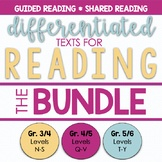
Also, if you’d like a walkthrough of how to prepare your students and yourself, this video is a great place to start: Prepare Your Students and Yourself for Guided Reading
Make the Most of Your 15-Minute Guided Reading Block
Junior guided reading sessions are short—usually just 10–15 minutes. That’s why it’s crucial to:
- Avoid first reads during this time
- Focus on targeted strategies (like inferencing or summarizing)
- Do quick fluency checks if needed
- Use the bulk of time for discussion, not decoding
- Assign follow-up tasks based on your conversation
Let students preview the text ahead of time, and come prepared to dive into meaning. Use this time as a bridge from shared instruction to independent mastery.
Key Tips for Guided Reading in Junior Grades
- Not all students need equal time—triage your support
- Guided reading is for assessment and instruction
- Keep it flexible, not fixed in a center rotation
- Focus on comprehension, not just fluency
Guided reading in junior grades isn’t about checking a box—it’s about giving the right kids the right support at the right time.
Need help getting started? Grab the Guided Reading Bundle or watch the setup video to see it in action.