


Description
WHAT IS THIS PRODUCT
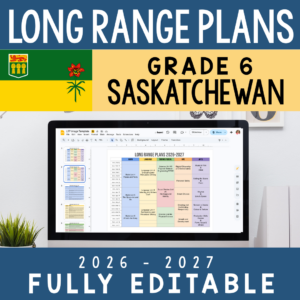
This is the editable Powerpoints version of the Saskatchewan Grade 6 Long-Range Plan — a full-year curriculum planning document aligned to the Saskatchewan curriculum. Unlike the free PDF version, this upgrade gives you a fully unlocked Powerpoints file you can make completely your own. Adjust unit timelines, add your own notes, swap in your school’s dates, and personalise every section to match how you actually teach. This is the planning tool that saves Saskatchewan Grade 6 teachers hours every single year.
This product is designed to support advanced thinking, writing, and leadership skills across all subject areas, giving you a clear, organised overview of the entire school year in one place.
WHO IS THIS FOR
This resource is for Grade 6 teachers in Saskatchewan who want to walk into September with their whole year mapped out — and the flexibility to make it their own. Whether you’re a first-year teacher who needs a clear starting point or an experienced educator who’s tired of building from scratch every year, this editable long-range plan gives you a professional, curriculum-aligned framework you can trust and customise.
WHAT’S INCLUDED
One editable Powerpoints long-range plan file covering the full school year for Grade 6 in Saskatchewan. The file includes unit overviews for all core subject areas: Language Arts, Math, Social Studies and Science, HPE, Drama and Music, and Visual Arts. All units are pre-populated with curriculum-aligned content. Simply make a copy of the Powerpoints file, and it’s yours to edit forever.
SUBJECTS COVERED
Language Arts, Mathematics, Social Studies and Science, Health and Physical Education (HPE), Drama and Music (Arts), Visual Arts.
LANGUAGE ARTS UNITS
Predicting and Expository Writing: Students master identifying main ideas with evidence, paraphrasing, and responding to texts. Writing develops multi-paragraph structure using the Oreo format, transitions, and revision. Grammar covers parts of speech, helping verbs, collective nouns, and adjectives and adverbs.
Connections and Narrative Plots: Students analyse plot structure, character traits, motivations, and how conflict drives narratives. Writing develops complex stories with subplots, character sketches, and setting influences, revised for advanced plot development. Grammar covers conjunctions, clauses, complex sentences, and punctuation.
Main Idea and Report Writing: Students write detailed summaries of fiction and non-fiction while analysing author’s purpose and point of view. Writing builds a five-paragraph research essay from thesis to conclusion using 3–5 sources. Grammar masters commas, colons, semicolons, and advanced quotation usage.
Evaluating and Persuasive Writing: Students analyse how facts, opinions, and bias shape arguments across complex texts. Writing develops advanced persuasive essays with strong evidence, counterpoints, and rhetorical strategies, refined for coherence. Grammar masters relative pronouns in complex sentences and reviews verb tense.
Inferring and Writers Craft: Students examine narrative forms across genres, analysing tension, perspective, symbolism, and irony. Writing develops layered narratives with complex character arcs, subplots, and advanced literary devices. Grammar masters linking verbs, perfect and progressive tense, and figurative language.
Synthesizing and Procedural Writing: Students analyse mood, tone, and bias across complex texts while paraphrasing and synthesising multiple sources. Writing develops detailed procedural texts with troubleshooting and variations, refined for clarity. Grammar masters modifier placement, parallelism, voice, and personal writing style.
MATH UNITS
How do Things Compare: Students read and write numbers up to 1,000,000, represent and compare decimals to thousandths, and apply fraction benchmarks to compare, order, and model fractions. They interpret data to draw conclusions and convert between metric units selecting appropriate units for context.
How Much More: Students apply flexible addition and subtraction strategies with numbers up to 1,000,000 and use estimation to check reasonableness. They apply the associative property, make mathematical decisions involving probability, and manage multi-step budgets in real-world financial contexts.
Groups and Balance: Students multiply multi-digit numbers using partial products and the standard algorithm, applying strategies to multi-step problems. They extend algebraic thinking by writing, evaluating, and simplifying variable expressions to represent real-world situations.
Pieces and Parts: Students apply integers in real-world contexts, perform operations with fractions and decimals including division by fractions, and estimate using standard algorithms. Probability connects to everyday decisions, while key skills like leadership, critical thinking, and teamwork are developed throughout.
The Space Around Us: Students classify and construct 2D and 3D shapes, calculate area and surface area, and apply angle properties. They plot and reflect points on a Cartesian plane and analyse linear growing patterns using tables, expressions, and graphs to identify correlations
What’s the Story: Students analyse histograms and line plots using summary statistics and intervals, and apply order of operations to solve equations with monomials and inequalities. Financial literacy covers interest, rates, and fees, while programming builds computational problem-solving skills.
SOCIAL STUDIES AND SCIENCE UNITS
Diversity of Living Things, Space Exploration, Canada & the World, Flight, Global Citizenship, Air & Aerodynamics
HPE UNITS
What is Community, Nutrition, Understanding Media Messages, Substance Use, Mental Health, Digital Citizenship and Online Safety, Personal Safety, Smart Choices, Creating and Contributing Responsibly, Growth and Development
ARTS AND DRAMA UNITS
Community Building, Genres in Music, Types of Drama, Musical Form, Body, Face and Voice, Music in Film, Setting the Scene, Rhythm, Tension in Drama, Production Skills Review
VISUAL ARTS UNITS
Colour, Line, Shape, Texture, Space, Value, Form, Line & Space, Colour & Texture, Form, Value & Shape
WHY TEACHERS LOVE IT
Long-range plans are one of the most time-consuming parts of back-to-school planning — and they’re also one of the most important. This editable version gives you a complete, professional, curriculum-aligned plan for Saskatchewan Grade 6 without spending your summer building one from scratch. The Powerpoints format means you can easily adjust timelines, move units, add your school’s specific details, and print or share with your administration. Thousands of Canadian teachers use Madly Learning resources to reclaim their planning time — this long-range plan is where a great year begins.
Keywords: Saskatchewan Grade 6 long-range plan, Grade 6 Saskatchewan curriculum, editable long-range plan Saskatchewan, Saskatchewan curriculum Grade 6, Grade 6 yearly plan, Canadian teacher resources Grade 6, Saskatchewan teacher planning, long-range plan editable Powerpoints


Reviews
There are no reviews yet.