


Description
WHAT IS THIS PRODUCT
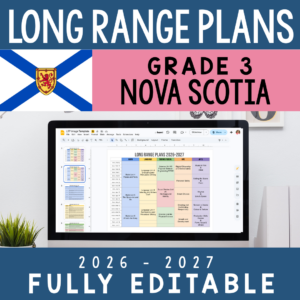
This is the editable Powerpoints version of the Nova Scotia Grade 3 Long-Range Plan — a full-year curriculum planning document aligned to the Nova Scotia curriculum. Unlike the free PDF version, this upgrade gives you a fully unlocked Powerpoints file you can make completely your own. Adjust unit timelines, add your own notes, swap in your school’s dates, and personalise every section to match how you actually teach. This is the planning tool that saves Nova Scotia Grade 3 teachers hours every single year.
This product is designed to support foundational skills and a love of learning across all subject areas, giving you a clear, organised overview of the entire school year in one place.
WHO IS THIS FOR
This resource is for Grade 3 teachers in Nova Scotia who want to walk into September with their whole year mapped out — and the flexibility to make it their own. Whether you’re a first-year teacher who needs a clear starting point or an experienced educator who’s tired of building from scratch every year, this editable long-range plan gives you a professional, curriculum-aligned framework you can trust and customise.
WHAT’S INCLUDED
One editable Powerpoints long-range plan file covering the full school year for Grade 3 in Nova Scotia. The file includes unit overviews for all core subject areas: Language Arts, Math, Social Studies and Science, HPE, Drama and Music, and Visual Arts. All units are pre-populated with curriculum-aligned content. Simply make a copy of the Powerpoints file, and it’s yours to edit forever.
SUBJECTS COVERED
Language Arts, Mathematics, Social Studies and Science, Health and Physical Education (HPE), Drama and Music (Arts), Visual Arts.
LANGUAGE ARTS UNITS
Predicting and Expository Writing: Students explore reading comprehension and foundational writing skills, including predictions, main idea, and responding to texts. Grammar covers nouns, verbs, adjectives, adverbs, and conjunctions, while writing progresses from sentences to coherent, well-edited paragraphs using transitions.
Connections and Narrative Plots: Students explore problem and solution plot structure, character, and setting through mentor texts. Writing develops from planned narratives to polished short stories with clear beginnings, middles, and ends. Grammar covers pronouns, proper nouns, adjectives, compound sentences, and capitalisation.
Main Idea and Report Writing: Students summarise fiction and non-fiction texts while identifying author’s purpose and point of view. Writing builds a two-paragraph research report from brainstorming through revision. Grammar covers punctuation, apostrophes, contractions, possessive nouns, and quotation marks.
Evaluating and Persuasive Writing: Students distinguish fact from opinion, identify bias, and draw conclusions from texts. Writing develops simple persuasive pieces using opinions, reasons, and figurative language, revised for clarity. Grammar covers subjects, predicates, pronouns, linking verbs, and prepositions.
Inferring and Writers Craft: Students analyse narrative structures, character-driven plots, symbolism, and themes across fables, myths, and legends. Writing develops complex narratives with conflict, figurative language, and foreshadowing, revised for pacing. Grammar covers linking verbs, progressive tense, interjections, and similes.
Synthesizing and Procedural Writing: Students identify mood, tone, and bias while paraphrasing and summarising texts. Writing focuses on clear, precise procedural texts revised for logical flow. Grammar covers misplaced modifiers, parallel structure, active and passive voice, and developing personal writing style.
MATH UNITS
How do Things Compare: Students explore place value, decimal equivalence, and fractional modelling and comparison. Data analysis and measurement benchmarks round out foundational number sense skills. *Financial Literacy content can be used as additional life skills learning
How Much More: Students develop addition and subtraction strategies up to 1,000 using number lines, rounding, and making change. Key concepts include commutative and associative properties, applied through word problems.
Groups and Balance: Students build multiplication understanding through repeated addition, arrays, place value models, and multiplicative comparison. Word problems and fast facts for 2, 5, and 10 develop fluency and real-world application.
Pieces and Parts: Students explore fractions, equivalent models, and operations including multiplication and division. Problem-solving strategies, probability on a number line, time with clocks, and real-world applications build conceptual understanding and mathematical reasoning.
The Space Around Us: Students classify 2D and 3D shapes, calculate area and perimeter, and measure capacity and mass. Map skills cover compass directions and creating maps, while patterning extends to tables and graphs.
What’s the Story: Students explore data vocabulary, graphing types, tree diagrams, and measures of mean and mode. Algebraic thinking introduces variables and equations, while a book drive project applies data collection, infographics, and basic coding in a real-world context. *financial literacy and coding content are addional learning opportunities.
SOCIAL STUDIES AND SCIENCE UNITS
Local Environment: Plants & Animals, Soils in the Environment, Communities: Local, National, Global, Magnetic & Electrostatic Forces, Mi’kmaw & African Nova Scotian Perspectives, Weather & Climate
HPE UNITS
What is Community, Nutrition, Understanding Media Messages, Substance Use, Mental Health, Digital Citizenship and Online Safety, Personal Safety, Smart Choices, Creating and Contributing Responsibly, Growth and Development
ARTS AND DRAMA UNITS
Community Building, Genres in Music, Types of Drama, Musical Form, Body, Face and Voice, Music in Film, Setting the Scene, Rhythm, Tension in Drama, Production Skills Review
VISUAL ARTS UNITS
Colour, Line, Shape, Texture, Space, Value, Form, Line & Space, Colour & Texture, Form, Value & Shape
WHY TEACHERS LOVE IT
Long-range plans are one of the most time-consuming parts of back-to-school planning — and they’re also one of the most important. This editable version gives you a complete, professional, curriculum-aligned plan for Nova Scotia Grade 3 without spending your summer building one from scratch. The Powerpoints format means you can easily adjust timelines, move units, add your school’s specific details, and print or share with your administration. Thousands of Canadian teachers use Madly Learning resources to reclaim their planning time — this long-range plan is where a great year begins.
Keywords: Nova Scotia Grade 3 long-range plan, Grade 3 Nova Scotia curriculum, editable long-range plan Nova Scotia, Nova Scotia curriculum Grade 3, Grade 3 yearly plan, Canadian teacher resources Grade 3, Nova Scotia teacher planning, long-range plan editable Powerpoints


Reviews
There are no reviews yet.