

If you teach in a junior classroom, you already know that keeping students engaged in math can sometimes feel like a challenge. Math projects are one of the best ways to make your lessons more hands-on and meaningful. They turn traditional math lessons into opportunities for exploration, creativity, and real-world problem-solving. Instead of just completing pages in a workbook, students get to plan, design, build, and present their ideas while using key math concepts along the way. Whether you’re teaching Grade 3 or Grade 6, math projects help your students connect the “why” behind the “what.” They give you authentic assessment opportunities and help your learners see how math shows up in the world around them.

Why Math Projects Are a Game-Changer
If you’ve ever had a student look up during math and ask, “But when am I ever going to use this?” math projects are your answer.
Math projects give students the why behind the what. They connect abstract concepts to real-world situations, invite creativity, and make math feel relevant. Whether it’s designing a dream bedroom using area and perimeter or planning a class party on a budget, projects let students apply what they’ve learned, not just memorize it.
And honestly? They make teaching math way more enjoyable, too.
What Are Math Projects, Exactly?
Math projects are hands-on, real-world tasks that ask students to use multiple math skills to solve a problem or create something meaningful.
They go beyond drills or worksheets. They are about thinking, problem-solving, and communicating ideas. In Grades 3 to 6, this could mean:
- Grade 3: Creating a miniature zoo using arrays and measurement
- Grade 4: Planning a “Math Mall” to explore decimals and money
- Grade 5: Building a scaled blueprint to connect fractions, geometry, and measurement
- Grade 6: Designing a theme park to apply area, ratio, and budgeting concepts
In each case, the focus isn’t just finishing a task. It’s giving students the chance to see math come alive.
Why Use Math Projects?
Let’s be real. Teaching math can sometimes feel like a juggling act. You’re differentiating, meeting curriculum expectations, and trying to keep everyone engaged (all before your coffee gets cold). Math projects help simplify that juggling act because they naturally:
- Build engagement. Students see relevance and choice, which keeps motivation high.
- Encourage inquiry. They spark curiosity and deeper thinking.
- Support differentiation. Open-ended tasks allow every student to enter at their own level.
- Provide authentic assessment. Projects give you meaningful evidence of understanding far beyond a traditional test.
Once students understand the routine of a math project, they become more independent each time you do one.

How to Use Math Projects in the Classroom
If you’re new to math projects, start small. Choose one unit where students can apply multiple skills, and follow these steps.
1. Introduce the Big Idea
Start with a real-world question such as, “How can we design the ultimate playground using what we know about area and perimeter?” This sparks curiosity and helps students connect math to something familiar.
2. Model the Process
Show examples of what a finished product might look like. Break the task into stages like brainstorming, planning, calculating, creating, and reflecting. This structure builds confidence and focus.
3. Encourage Collaboration
Group projects can be powerful, especially when each student has a role such as recorder, designer, calculator, or presenter. Collaboration mirrors real-life problem-solving.
4. Use Rubrics to Guide Learning
Post the rubric or success criteria early on. When students know what success looks like, their work and confidence grow quickly.
5. Assess Along the Way
Collect anecdotal notes, check-ins, or exit slips. Projects are full of opportunities for formative assessment.
A Peek Inside an Ignited Math Project
If you’re part of the Ignited Math program, you already have a complete project included in every unit (A through F). Each project connects directly to the Ontario and other Canadian curricula for Grades 3 to 6.
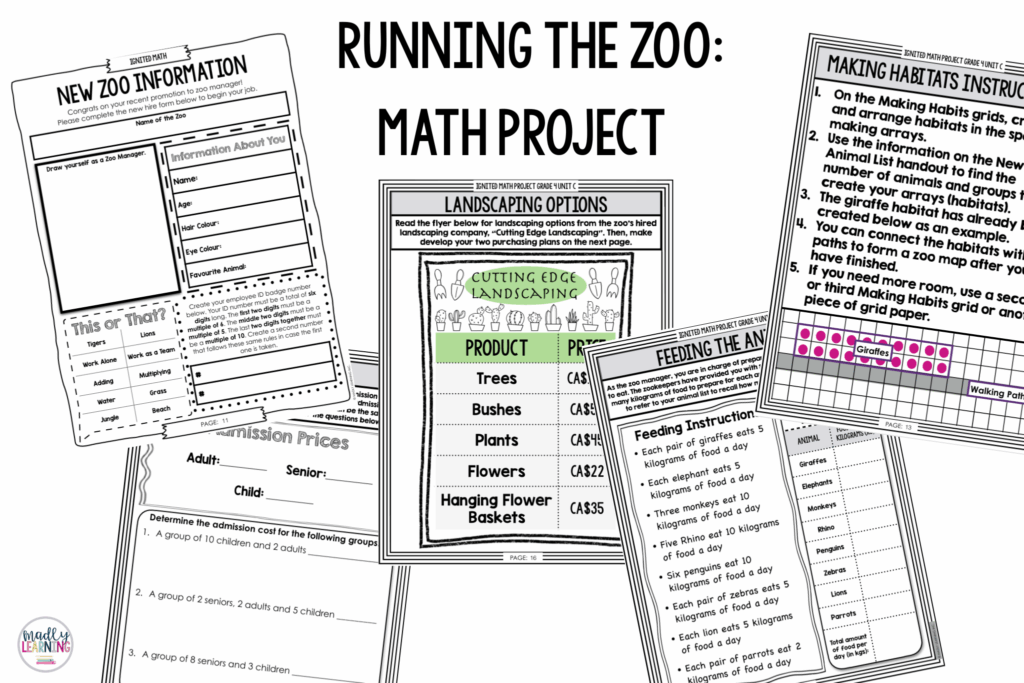
For example, in the Grade 4 Unit C project, “Running the Zoo,” students take on the role of a newly promoted zoo manager responsible for planning and managing their zoo. They use their knowledge of multiplication, arrays, word problems, budgeting, and simple algebraic expressions to solve practical challenges throughout the project.
Students:
- Create and organize animal habitats using arrays based on multiplication groupings.
- Plan a landscaping budget by calculating totals and staying within a $ limit.
- Manage daily operations by calculating animal feeding quantities using multiplication and reasoning.
- Set admission prices, solve word problems for different ticket combinations, and explore marketing math through advertising scenarios.
The resource includes:
- A student project booklet guiding learners through each step of the inquiry process.
- A teacher guide outlining curriculum connections, assessment opportunities, and differentiation ideas.
- A rubric that supports consistent, stress-free assessment of multiplication and problem-solving skills.

Tips for Making Math Projects Successful
- Keep the routine simple. The first project takes the most time, but it gets easier each round.
- Use student voice. Let them make choices about the topic or format.
- Celebrate learning, not perfection. Highlight effort, creativity, and problem-solving.
- Reflect together. Have students share what strategies worked and how they saw math in real life.
Try It Yourself or Save Time with Ignited Math
You can absolutely create your own math projects using these ideas, and your students will love them. But if you want to save time, Ignited Math has everything ready to go:
- Six complete units (A–F) for Grades 3 to 6
- A built-in math project in every unit
- Fully aligned to the Ontario and Canadian curricula
Each project is designed to make math engaging and effective without adding extra work for you.
Explore Ignited Math and get ready-to-teach math projects that make learning meaningful.
Wrapping It All Up
Math projects are one of the most powerful ways to bring energy and authenticity into your classroom. They help students see that math isn’t just numbers on a page—it’s creative, flexible, and everywhere in their daily lives. When students work on meaningful projects, they build confidence and start thinking like real mathematicians.
So whether you decide to create your own projects or use the ready-to-teach ones in Ignited Math, the goal is the same: make math hands-on, relevant, and joyful for every student.
FAQs About Math Projects
How long should a math project take?
Usually three to five class periods is perfect. You can scale it up or down as needed.
Should I grade every part of a project?
No. Use check-ins for formative feedback and only grade the final reflection or product.
What if students struggle to stay on task?
Set clear daily goals and add accountability checkpoints. Structure helps everything run smoothly.
Can I use math projects with split grades?
Yes. Projects naturally differentiate, so you can adjust expectations for each grade easily.
Need help managing all the moving parts of your math block? I’ve got you! Read this post on simplifying math centers — it’s the perfect next step after exploring the Running the Zoo project.